美国宇航局:在火星发现液态水活动“强有力”的证据
美国宇航局28日宣布,在火星表面发现了有液态水活动的“强有力”证据。
美国宇航局(NASA)28日宣布,在火星表面发现了有液态水活动的“强有力”证据。
这一发现来自美国宇航局的火星侦察轨道器(MRO),MRO所拍摄的怪异黑色条纹已经被证实是由火星上的液态水形成。此前,火星上的水一直被认为是以固态冰的形式存在,这证实了火星上有液态水的猜测。
火星上的平均温度比地球要寒冷得多,大约是零下80摄氏度,而在火星赤道附近的夏天,温度又可以达到正70摄氏度,在条件足够的情况下,高氯酸盐液态水有可能会以液态的形式存在,因为水和高氯酸盐形成盐水溶液,其具有比水低得多的冰点,最终这些水被汇集到较低的部位。
此前NASA一直怀疑,流动的液态水形成了奇特的黑色条纹,这种条纹由MRO在2010年时发现,这种条纹在温暖的季节会变粗和长,而在寒冷的时候会褪色的缩小,这正是液态水在转换时的特征:水和盐参与了这些变化。
今天发表的新研究报告提供了直接证据证明液态水确实参与了这一过程,MRO的成像光谱仪分析了其中的化学成分,黑色条纹中确实包含水分子和盐的晶体结构。
此次发现让NASA在帮助人类认识火星的道路上迈出了重要一步,水的发现可以让微生物在这片红色星球的存在成为可能。
以下为NASA官网原文:
NASA Confirms Evidence That Liquid Water Flows on Today’s Mars
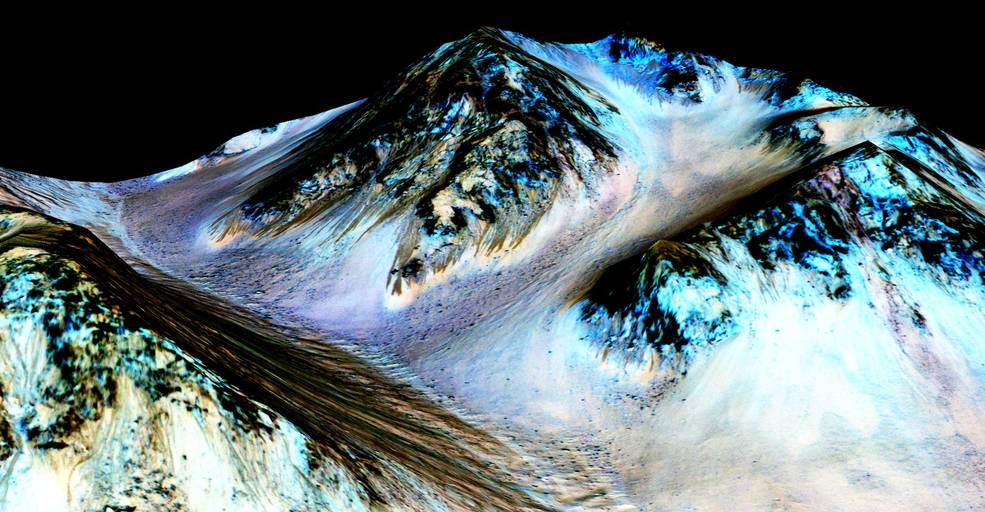
New findings from NASA's Mars Reconnaissance Orbiter (MRO) provide the strongest evidence yet that liquid water flows intermittently on present-day Mars.
Using an imaging spectrometer on MRO, researchers detected signatures of hydrated minerals on slopes where mysterious streaks are seen on the Red Planet. These darkish streaks appear to ebb and flow over time. They darken and appear to flow down steep slopes during warm seasons, and then fade in cooler seasons. They appear in several locations on Mars when temperatures are above minus 10 degrees Fahrenheit (minus 23 Celsius), and disappear at colder times.
“Our quest on Mars has been to ‘follow the water,’ in our search for life in the universe, and now we have convincing science that validates what we’ve long suspected,” said John Grunsfeld, astronaut and associate administrator of NASA’s Science Mission Directorate in Washington. “This is a significant development, as it appears to confirm that water -- albeit briny -- is flowing today on the surface of Mars.”
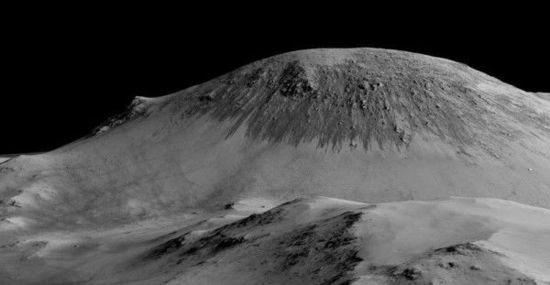
These downhill flows, known as recurring slope lineae (RSL), often have been described as possibly related to liquid water. The new findings of hydrated salts on the slopes point to what that relationship may be to these dark features. The hydrated salts would lower the freezing point of a liquid brine, just as salt on roads here on Earth causes ice and snow to melt more rapidly. Scientists say it’s likely a shallow subsurface flow, with enough water wicking to the surface to explain the darkening.
"We found the hydrated salts only when the seasonal features were widest, which suggests that either the dark streaks themselves or a process that forms them is the source of the hydration. In either case, the detection of hydrated salts on these slopes means that water plays a vital role in the formation of these streaks," said Lujendra Ojha of the Georgia Institute of Technology (Georgia Tech) in Atlanta, lead author of a report on these findings published Sept. 28 by Nature Geoscience.
Ojha first noticed these puzzling features as a University of Arizona undergraduate student in 2010, using images from the MRO's High Resolution Imaging Science Experiment (HiRISE). HiRISE observations now have documented RSL at dozens of sites on Mars. The new study pairs HiRISE observations with mineral mapping by MRO’s Compact Reconnaissance Imaging Spectrometer for Mars (CRISM).
The spectrometer observations show signatures of hydrated salts at multiple RSL locations, but only when the dark features were relatively wide. When the researchers looked at the same locations and RSL weren't as extensive, they detected no hydrated salt.
Ojha and his co-authors interpret the spectral signatures as caused by hydrated minerals called perchlorates. The hydrated salts most consistent with the chemical signatures are likely a mixture of magnesium perchlorate, magnesium chlorate and sodium perchlorate. Some perchlorates have been shown to keep liquids from freezing even when conditions are as cold as minus 94 degrees Fahrenheit (minus 70 Celsius). On Earth, naturally produced perchlorates are concentrated in deserts, and some types of perchlorates can be used as rocket propellant.
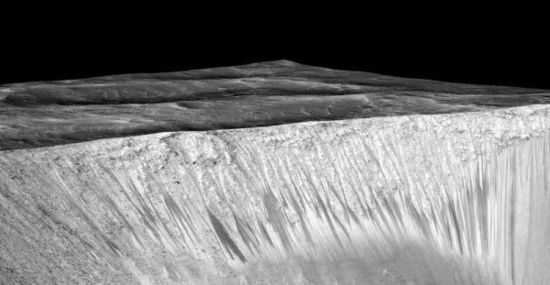
Perchlorates have previously been seen on Mars. NASA's Phoenix lander and Curiosity rover both found them in the planet's soil, and some scientists believe that the Viking missions in the 1970s measured signatures of these salts. However, this study of RSL detected perchlorates, now in hydrated form, in different areas than those explored by the landers. This also is the first time perchlorates have been identified from orbit.
MRO has been examining Mars since 2006 with its six science instruments.
"The ability of MRO to observe for multiple Mars years with a payload able to see the fine detail of these features has enabled findings such as these: first identifying the puzzling seasonal streaks and now making a big step towards explaining what they are," said Rich Zurek, MRO project scientist at NASA's Jet Propulsion Laboratory (JPL) in Pasadena, California.
For Ojha, the new findings are more proof that the mysterious lines he first saw darkening Martian slopes five years ago are, indeed, present-day water.
"When most people talk about water on Mars, they're usually talking about ancient water or frozen water," he said. "Now we know there’s more to the story. This is the first spectral detection that unambiguously supports our liquid water-formation hypotheses for RSL."
The discovery is the latest of many breakthroughs by NASA’s Mars missions.
“It took multiple spacecraft over several years to solve this mystery, and now we know there is liquid water on the surface of this cold, desert planet,” said Michael Meyer, lead scientist for NASA’s Mars Exploration Program at the agency’s headquarters in Washington. “It seems that the more we study Mars, the more we learn how life could be supported and where there are resources to support life in the future.”
(综合自NASA官网、cnbeta网站;编辑:李剑华)
(作者:21Plus )
21世纪经济报道及其客户端所刊载内容的知识产权均属广东二十一世纪环球经济报社所有。未经书面授权,任何人不得以任何方式使用。详情或获取授权信息请点击此处。