Global Echoes on China | Teo Siong Seng: China remains committed to opening up


南方财经全媒体集团全国两会报道组 施诗 杨雨莱 北京、广州报道
With the “Two Sessions” coming on March 4, 2025, the sessions of the National People's Congress, and the National Committee of the Chinese People's Political Consultative Conference, China's biggest annual political event, set to start on, while global attention will be riveted on the country's policy moves and economic trends.
Teo Siong Seng, the Chairman of the Internationalisation Action Committee (IAC) of the Singapore Business Federation (SBF), as a witness to China’s development over the years, has conducted an exclusive interview with SFC journalist to discuss further on China’s opening up, high-quality development, China-Singapore cooperation outlook and so on.
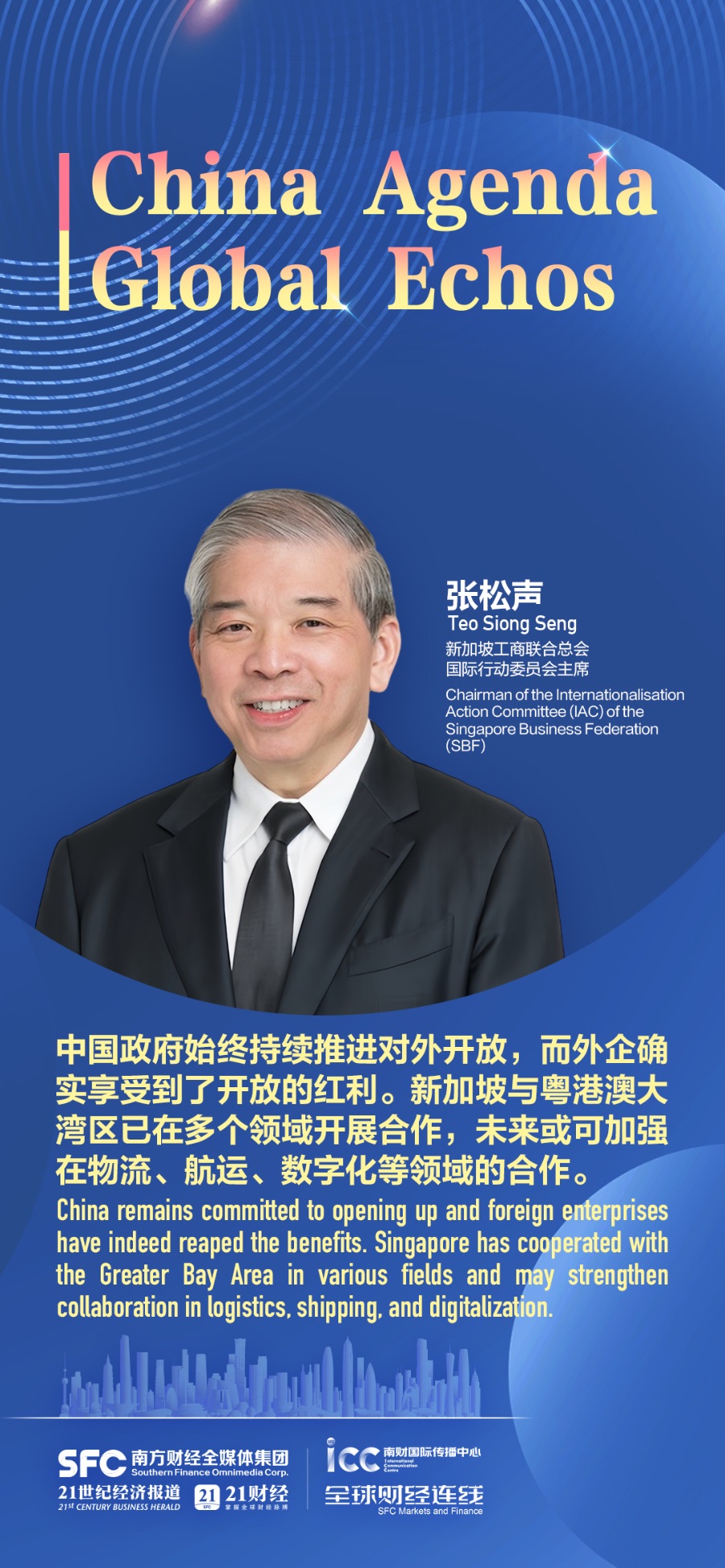
Teo noted that China remains committed to opening up, relaxing the market access, where the foreign enterprises have indeed reaped the benefits in the last several decades. “The government is very much involved in listening to us and to see how we can work together”, he said.
For further development of foreign investment in China, Teo expressed that “I see the opportunity for foreign company is different now”. He emphasized that Singapore-China cooperation is now less about merely providing capital or technology, and more about leveraging the strengths of Chinese companies in conjunction with the marketing expertise and historical connections of Singaporean firms to achieve a win-win outcome.
During the interview, Teo highlighted the strong impression that the Guangdong-Hong Kong-Macao Greater Bay Area (GBA) had left on him. He noted that the cities within the GBA each possess distinct advantages, ranging from manufacturing hubs to emerging tourism destinations. With collaborative efforts, the GBA is poised to emerge as a powerful and effective economic region. Teo also pointed out that Singapore has already engaged in cooperation with the GBA across various fields and may further strengthen collaboration in logistics, shipping, and digitalization.
The GBA Features on Openness & Diversity
SFC Markets and Finance: I know recently you and SBF members took a trip to the Greater Bay Area. What takeaway did you have?
Teo Siong Seng: From the 12 to 14 of January this year, we led a delegation from SBF (Singapore Business Federation), first of all, to Hong Kong to attend the Asia Financial Forum. This is the first time Singapore sent a delegation at the invitation by the Hong Kong SAR government and the Hong Kong TDC. It was eye-opening for us to see the scale and the depth of the forum, and there are many participants. Two Singapore companies, XDC Network and Klaara, also took part in the sideshow called Deal Flow and Fintech to showcase the capability. And they met many customers from China and from outside China.
In the exhibition, we also see many fintech companies showcasing their capabilities and it's a great learning for us. At the same time, we had a high-level closed-door meeting led by our Singapore Deputy Prime Minister, Minister of Trade Industry Mr. Gan Kim Yong and his counterpart. 110 top businessmen from both sides attended this meeting and there were very frank view exchanges. SBF also signed an MOU (Memorandum of Understanding) with the Hong Kong General Chamber of Commerce to commit to further cooperation between the two business communities.
Many Hong Kong businesses have been in Singapore for a long time, and some of them from there go into Southeast Asia. Similarly, many Singapore companies have been in Hong Kong for a long time, and from there to go into China. So what I call "Ni Zhong You Wo, Wo Zhong You Ni" (we are inextricably linked), and also for many years, the cultural, the people-to-people connection is very strong. So while the two economies do compete, I think we can complement each other, especially in this current uncertain world. So I think the meeting was very good. It's a closed-door conference. Then from there, we went to Qianhai in Shenzhen. We visited a few companies in logistics, Fintech, and also in green financing. So we can see that the vibrancy of the Greater Bay Area, and I think it can provide many opportunities for Singapore companies.
SFC Markets and Finance: Actually, Shenzhen is a rising innovation center globally. What do you think about Shenzhen?
Teo Siong Seng: Shenzhen has always been an open city, attracting talent. For the last 10 to 15 years, it has been at the forefront of innovation and technology for China. Many companies have started there. Many very successful companies are there like Huawei, Tencent. And I see that the good thing about Shenzhen is that government is very pro-business, attracting young people from the Chinese mainland and Hong Kong to go there to set up the office, providing them very good environment and incentives. Plus, low-cost affordable housing so that they can settle down and release their energy and creativity. So it's very impressive.
SFC Markets and Finance: As one of the most dynamic areas in China, what impression does the Greater Bay Area leave on you?
Teo Siong Seng: The Greater Bay Area, comprises, I believe, of 11 counties and cities. Each of them has their own characteristics. Some of them are old manufacturing bases like Foshan and Dongguan, some are very new, for example, Huizhou, which is also developing into tourism and leisure. So I think the Greater Bay Area itself has a lot of diversity. But more important is working together. It will become a very powerful and effective economic region in Southern China.
New Opportunities for Singaporean Enterprises in the GBA
SFC Markets and Finance: What industries can the GBA and Singapore cooperate?
Teo Siong Seng: A few of them, one of them is shipping and logistics. I think the ports like Hong Kong, Yantian, Nansha (Guangzhou), Shekou are all very important ports, and so is Singapore. So especially in a time like this, where you can have a disruption in the supply chain. So the ports can work together. So that when a certain port has a difficulty, the other port can support it. I believe that, in this world of instability, it's more important that regional ports work together and complement each other. So in shipping logistics, we can do a lot of cooperation. The other is digitalization, Shenzhen is very advanced, so is Singapore pushing for it, so companies on both sides can cooperate. And also, in terms of green energy, green financing, and sustainability. So that's how I see many fields that both sides can work together.
SFC Markets and Finance: Are there any new cooperations or products coming up?
Teo Siong Seng: We have the Sino-Singapore Guangzhou Knowledge City. I was actually the director at the beginning. I’m very glad to see that this city now is developing and has matured to become a very important platform in Guangzhou for innovation, also in areas like intellectual properties and design. And of course, Singapore and Shenzhen also have these councils to cooperate. So I think there's a lot we can do in terms of exchange of talent, in terms of connectivity, even in the areas of, legal, arbitration, so that we can complement each other. So there are many areas which we can cooperate.
Embrace New Perspectives of Foreign Investment in China
SFC Markets and Finance: You are a witness to China's opening up. Over the years, China's door is opening even wider to foreign companies. What do you think about this trend, and what opportunities will this trend bring to foreign companies?
Teo Siong Seng: I started coming to China in 1980, immediately after the opening up. I see, at that time, China opened up to attract foreign capital, attracting market access to foreign partners. And many companies have enjoyed the fruit of China's opening. And of course, over the 40 years, China's economy has grown a lot. And it's now a very huge economy. So where last time the shortage of capital, shortage of market access and technology, this doesn't exist anymore, many Chinese companies now are even financially much stronger than us. They are also very advanced. Plus, what is important is that they have a lot of human resource capital. Some are very resilient and very robust. And many Chinese companies are very ambitious. And they have foresight. I think what Singapore companies can do is actually learn from them. How they can actually complement us? The more I see is actually the opportunity to work together to go to a third country (region), for example, Southeast Asia, or it can be South Asia like Bangladesh, India, Sri Lanka, or even going to Africa. So I see the opportunity for foreign company is different now. It's not so much of providing capital or providing technology, but more using the strength of Chinese companies together with the marketing experience and historical links of Singapore companies so that we can come together and become a win-win.
SFC Markets and Finance: Would you like to share some details on your company's business in China?
Teo Siong Seng: China today accounts for about 50% of PIL's total top line, like many other international shipping companies. And we have been in China, in fact, since 1967. That is 58 years already. We have seen the changes in China and that actually has benefited our company. So we see that as China develops, we will continue to play our part, especially in the development of China to the Belt and Road countries. The BRI, traditionally, has been very strong in Southeast Asia, in the Pacific Islands, in South Asia, in the Middle East, Africa and Latin America. And these are the countries where I think that China will continue to grow not only in terms of exports but also imports and also direct investment. So these are the areas that I think my company can further cooperate with Chinese companies in terms of goods that they want to export. Or even in terms of harnessing talent from China, as I think China has a lot of talent. I think it can complement our company growth, not only in Singapore but in the other third country. We have some Chinese colleagues who are working with us in Africa, in Latin America and in Southeast Asia.
SFC Markets and Finance: What does the Chinese market mean for your company?
Teo Siong Seng: The Chinese market is very big, but also very competitive. For us, we have to be mentally prepared. It's not like what it used to be 40 years ago. We have to show what is the value we can bring. But besides saying that Singapore has a good name in China, Singapore is a brand, a brand of trust, quality and consistency. That's why we have to choose the right field and choose the right partner to develop in China.
China's Business Environment and Policy Advantages
SFC Markets and Finance: Actually, the Chinese government did a lot on business climate. What do you think about the current business climate in China?
Teo Siong Seng: The climate at the moment, of course, is challenging. China has been growing at a very high speed for 30 years. I believe, this year, the target is around 5%. But even 5% is a very high target, because the base is very big now. I think the climate is improving. But some of that is beyond China's control, such as the geopolitics, the inflation, climate change and energy problems. I think the Chinese government is very consistent and continues to be open to foreign investment, and continues to bring foreign company.
I think the climate is difficult, but it's not only China. The whole world is difficult. But one thing about China is that the government is very much involved in listening to us and to see how we can work together, it is not only us, but the Chinese companies are improving their business.
SFC Markets and Finance: Do you expect more policies will be released to foreign enterprises?
Teo Siong Seng: We hope so. I think one is whether the "Qing Dan" (Special Administrative Measures for Foreign Investment Access) can be further improved, so that we can be involved in more businesses. But as I said already, many businesses in China are very competitive, if we want to come in, we must be able to join them to be very competitive.
So I hope that can be more relaxed. And of course, many places already have made the procedure simplified. And I hope it can be further simplified, because then it makes our business cost lower.
China-Singapore’s Cooperation Under the High-Quality Development
SFC Markets and Finance: The Chinese economy is shifting into high-quality development. How will this influence the global supply chain?
Teo Siong Seng: I think that would mean that certain businesses that are low-tech, maybe labor-intensive will move out of China. And it's already happening. So it may mean that it will move faster. And also the high quality, the technology growth, is the right thing to do. But of course, change is always painful. Even as a company in China, we are changing to adopt more technology, so that will also affect our traditional way of doing.
So we have to embrace it. At the same time, we have to handle it more with a human focus. "Geng Ren Xing Hua" (to be more human-centered), I think that's important. Because, after all, the Chinese are hardworking, very industrious and also, to me, very resilient. So I think they will succeed.
SFC Markets and Finance: Based on high-quality development, how can China and Singapore enhance cooperation?
Teo Siong Seng: As I say, because both sides have their advantages. China has the market, China has the capital, China has the people. Singapore is small, but Singapore is, how we say, "Xiao Er Jing" (small but developed). So there are many areas, we believe, like the legal framework, certain insurance arbitration, all I think we can work together.
Multilateral Cooperation Is the Need of the Hour
SFC Markets and Finance: In terms of ASEAN development. How can Singapore and China enhance multilateral cooperation?
Teo Siong Seng: ASEAN is already China's largest trading block for the last three years. It will continue to do so. And ASEAN, I think by 2035, will be the fourth largest economic block in the world, with a very young population. So I think it's good that China can participate in ASEAN’s growth. And Singapore, being a city-state, can play a role in helping Chinese companies go into ASEAN. Hopefully, they will use Singapore to set up a regional HQ to go into ASEAN and can also cooperate with Singapore companies.
SFC Markets and Finance: You mentioned the BRI several times. How do you think about the future of the BRI?
Teo Siong Seng: The BRI, I think will change from the time it was proposed. I think it has been progressing. But, maybe in the future, what we call "Xiao Er Jing" (small but developed), rather than very big project. And also besides the Chinese state-owned companies, more Chinese private companies can take part in it.
Chief Producer: Yu Xiaona
Supervising Producer: Shi Shi
Editor: Li Yinong
Reporter: Shi Shi, Yang Yulai
Video Editor: Li Qun, Cai Yutian
New Media Coordination: Ding Qingyun, Zeng Tingfang, Lai Xi, Huang Daxun
Overseas Operations Supervising Producer: Huang Yanshu
Overseas Content Coordinator: Huang Zihao
Overseas Operations Editors: Zhuang Huan, Wu Wanjie, Long Lihua, Zhang Weitao
Produced by: Southern Finance Omnimedia Group
(作者:施诗,杨雨莱 编辑:李依农)