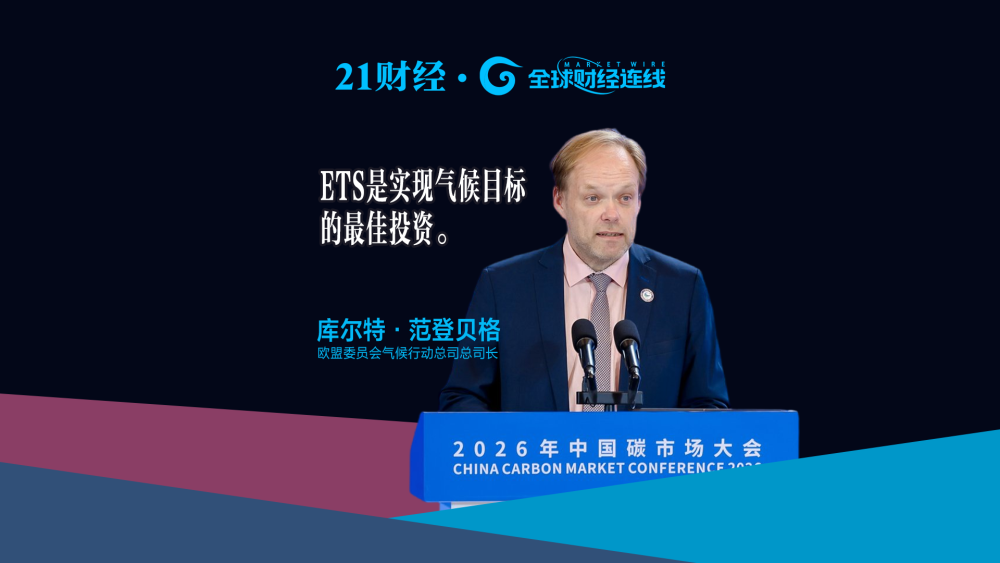
EU Climate Chief Kurt Vandenberghe: ETS Is the Best Investment for Achieving Climate Goals


SFC Correspondent Lu Taoran, Li Deshangyu
Carbon markets are fast becoming the central instrument of global climate governance.
“The best thing that China can do, based on our experience with the EU ETS, is to move from an intensity-based emissions trading system to a system based on an absolute cap,” said Kurt Vandenberghe, Director-General for Climate Action at the European Commission, in an exclusive interview with 21st Century Business Herald (21CBH) on the sidelines of the 2026 China Carbon Market Conference.
Vandenberghe noted that the EU Emissions Trading System (EU ETS) is the oldest carbon market in the world, while China's national emissions trading scheme is now the largest. He also pointed out that China’s installed solar power capacity has already surpassed its coal-fired capacity, giving the country "incredible potential" to reduce its reliance on coal, gas, and oil and to profit from clean energy such as solar and wind.
Meanwhile, Vandenberghe said the Open Coalition on Compliance Carbon Markets is evolving from a start-up platform into a reference institution for setting the global carbon market agenda, while promoting effective carbon pricing and interoperability. The EU is preparing for COP31 in Antalya, Türkiye, with the goal of turning emission ambitions into implementation.
China's carbon market has ample room for faster emission cuts
SFC Markets and Finance: How do you view the linkage among carbon markets across major economies? Against the backdrop of intensifying climate impacts, what role can carbon markets play?
Vandenberghe: The effects of El Niño will be more brutal because of climate change. Scientists tell us that the El Niño this year and next year will be the worst in terms of its effects. So the best thing we can do is to reduce emissions as rapidly as possible—and that's where carbon markets and carbon prices come in, because that is the most cost-efficient way to reduce emissions. The quicker and the more we reduce emissions, the weaker El Niño's impacts will be in the future.
It is very important that the major economies and the major emitters in the world work together on carbon markets. We applaud China's work on its ETS. The European Union has the most mature ETS in the world; China now has the largest one. But China still has incredible scope for rapidly decreasing emissions using carbon markets and carbon pricing. China now represents 30% of global emissions, so there is significant scope for reducing those emissions as rapidly as possible. From the European Union, we are very keen to further collaborate and deepen our collaboration with China to make the China ETS even more effective than it is today.
In October, the EU and China will hold the High-Level Environment and Climate Dialogue, where we hope to report on the progress of our cooperation and set priorities for the next phase. EU-China cooperation on the ETS can serve as a model: we run continuous training programs, including training for practitioners, and we support joint research on China's ETS to help it move from intensity control to absolute cap control.
Of course, we are not asking China to copy all of the EU's approaches. Every economy and every jurisdiction is different. We are happy to share the experience we have gained—including the mistakes we have made—so that our partners do not have to repeat them.
SFC Markets and Finance: In your view, what is the single biggest gap preventing carbon markets from becoming truly effective at cutting global emissions? Are carbon markets sufficiently designed to address the kind of emission rebounds driven by climate shocks?
Vandenberghe: Based on our experience with the EU ETS, the best thing to do is to put a cap on emissions and reduce the cap every year. If you then also have more auctioning of allowances rather than giving the allowances for free, you will see a rapid decrease in emissions—and also increased investments and innovation in modernizing your economy.
Established in 2005, the EU ETS operates in 30 countries and covers around 40% of the bloc's emissions, spanning power, heat, industrial production, maritime transport, and aviation. It is built on an absolute cap that declines every year, giving investors confidence. According to the figures we released during the conference, the sectors covered by the EU ETS have achieved a 50% reduction in emissions since 2005. The current EU carbon price stands at around €55 per tonne of CO2, equivalent to roughly CNY 430. The bloc is on track to meet its target of cutting emissions by 62% by 2030. Since 2013, the ETS has generated around €270 billion in revenues, which have been reinvested in the transition.
The ETS is driving a lot of investment in renewable energy and clean energy, including nuclear energy—these are the energy sources of the future. I see with great happiness that in China there is now more solar power capacity than coal-based capacity. So China has incredible potential to reduce its reliance on coal, gas, and oil, and to really profit from clean energy, including solar and wind.
Global carbon market interoperability to accelerate on the eve of COP31
SFC Markets and Finance: On the sidelines of the conference, the Open Coalition on Compliance Carbon Markets held its second high-level meeting. Against the backdrop of the implementation of Article 6 of the Paris Agreement and the preparations for COP31, how do you view interoperability among carbon markets worldwide? What role will carbon removals and international credits play?
Vandenberghe: Despite geopolitical headwinds, international cooperation is only increasing. The Open Coalition is evolving from a start-up platform into a reference institution for the global carbon market agenda, while promoting effective carbon pricing and interoperability. Based on my exchanges with all partners, members, and observers, everyone is eager to advance the interoperability of carbon markets.
We are preparing for COP31 in Antalya, with the goal of moving from emission ambitions to the implementation of those ambitions. Carbon pricing and carbon markets are the most effective tools we have to deliver our global climate goals under the Paris Agreement and our nationally determined contributions.
On carbon removals, we will use 250 million tonnes of high-quality, permanent domestic carbon removal credits within the ETS to kick-start the carbon removals market. We are also contributing to international aviation and maritime transport, supporting CORSIA and the IMO's Net-Zero Framework. And we will further strengthen the ETS's stability mechanism—price stability is essential for predictability for investors.
SFC Markets and Finance: The EU is pursuing ETS reform to align with its 2040 climate target, and the phase-out timetable for free allowances in sectors covered by the Carbon Border Adjustment Mechanism (CBAM) has drawn wide discussion. Some observers argue such adjustments are driven by industrial competitiveness. Amid geopolitical headwinds, what is the red line the EU will not cross?
Vandenberghe: The red line the EU will not cross is giving up on our ambition. We have agreed to reduce our emissions by 90% by 2040, on the way to climate neutrality by 2050. We will not do anything that compromises that objective. We have proposed to reform the ETS to align it with our 2040 goals and to really mobilize much more investment and innovation, thanks to the EU ETS.
The reform package proposed by the European Commission in July has three objectives: climate, economy, and security—cutting emissions at lower cost, growing the economy, and strengthening global competitiveness. In the wake of recent geopolitical conflict, the EU has paid an extra €80 billion for oil and gas imports without importing any additional energy—volumes have not increased, but costs have risen by €80 billion. For all parties, including China, there is a strategic interest in moving away from fossil fuels.
The design principle of the reform is to drive investment and innovation: rewarding the frontrunners in industry while supporting those catching up. We have introduced more flexibility—for example, free allocations can come with investment conditions, so that ETS revenues flow back to the industries that pay into the system and finance their decarbonization. We want to scale up carbon removals and incentivize the circular economy, and to open the ETS indirectly to international carbon credits: from 2036 onwards, the EU will purchase 260 million tonnes of high-integrity international carbon credits, which will be used centrally by EU institutions rather than for direct compliance. By 2028, the ETS will cover 75% of the EU's emissions, and we will set up a €100 billion fund to support lower-income regions and households.
Carbon pricing and carbon markets are our most effective tools for delivering on the Paris Agreement and our nationally determined contributions. The ETS should be the best investment—helping us achieve our climate goals, modernize our economies, and safeguard our societies. We very much look forward to deepening our cooperation with China and all our partners.
Chief Producer: Zhao Haijian
Supervising Producer: Shi Shi
Editor: Li Yinong
Reporter: Lu Taoran, Li Deshangyu
Video Editor: Cai Yutian
New Media Coordination: Ding Qingyun, Zeng Tingfang, Lai Xi
Overseas Operations Supervising Producer: Huang Yanshu
Overseas Content Coordinator: Huang Zihao
Overseas Operations Editors: Zhuang Huan, Wu Wanjie, Long Lihua, Zheng Quanyi
Produced by: Southern Finance Media Group
(作者:卢陶然 编辑:李依农 视频编辑:蔡于恬)